When the Creative Economy Advancement and Tourism Expansion (CREATE) Plan launched last year, it called for bold, actionable steps to better support Delaware’s creative economy. Today, we’re already seeing those recommendations take root in a meaningful way.
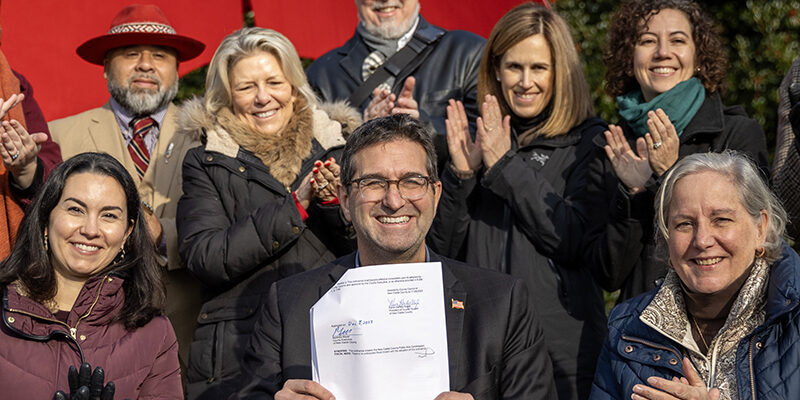
In December 2023, New Castle County passed Ordinance 23-160, creating its first Public Arts Commission, a milestone that recognizes the arts as cultural infrastructure while advancing Delaware’s broader economic development goals.
The Commission, a nine-member body, is charged with shaping policies to integrate art into public spaces and development projects, overseeing acquisitions, and reviewing conservation and relocation plans for County-owned works. While still in its early stages, the Commission represents a significant step forward in aligning Delaware’s cultural policy with economic development goals.
Councilwoman Dee Durham, who spearheaded the ordinance, said the idea grew out of work along the Concord Pike Corridor, where redevelopment is already underway. She recalled, “Wouldn’t it be great if we had some sort of program that encouraged public art to be implemented as redevelopment occurs in the Concord Pike Corridor, but obviously everywhere as well.”
That vision quickly gained traction. Working with stakeholders, Durham outlined a three-step process: first, create the Commission; next, establish a “percent for art” requirement in county projects, dedicating at least one percent of construction costs for State buildings to acquiring and installing works of art; and ultimately, extend the policy to private development.
She explained, “Ordinance 23-160 had the goal of establishing the New Castle County Public Arts Commission because that was really the first step in taking additional steps to getting more funding for the arts, getting a framework that would guide future efforts, which was really my initial goal.”
Already, the Commission has hosted its first public art competition, showcasing work from local artists in the County Executive’s offices. But the significance of this step is bigger than a single project. As Cheryl Mack, Chairwoman of the Commission, explained, “New Castle County has shown tremendous leadership demonstrating no matter what’s happening at the national level, the county will take care of the arts needs of the community.”
That local leadership, she said, creates momentum across the economy. She noted, “It’s a revenue generator for the artists. Once dollars are going towards supporting a local artist, it just resonates and kind of triples within the community because it goes from the artist supporting a local business, local business hiring employees, and that dollar just circulates within the community.” That kind of reinvestment is exactly what CREATE Plan Recommendation #12 calls for—identifying new revenue streams to sustain Delaware’s creative economy.
Durham also highlighted how public art drives long-term growth. “Job growth, enhancing the creative economy, can obviously bring in jobs, support tourism, which then supports all the businesses that are related to tourism, the hotels, restaurants, all the attractions we have in the area. I know that in the Philadelphia area, the mural arts program is a huge tourist attraction. And there’s no reason why we can’t incorporate that down here,” she said. This vision reflects CREATE Plan Recommendation #10, which calls for increasing cultural tourism offerings across the state.
That perspective reflects one of the CREATE Plan’s core goals: ensuring that arts policy strengthens both Delaware’s communities and its economy. As Neil Kirschling, Executive Director of the Delaware Arts Alliance, put it, “The New Castle County Public Arts Commission really shows the ideals of the CREATE Plan, which is that support for the arts can come from anywhere. It can come from county government, local government, state government, private or public sector.”
Kirschling emphasized that the Commission is already demonstrating progress on two CREATE Plan recommendations: identifying new revenue streams and developing cultural tourism opportunities.
“This is the first county in Delaware to undertake this sort of percentage-for-art program,” he noted. “We hope it can be a model for other cities and counties across Delaware that, with a small amount of funding, they can make their spaces beautiful and put in place public art that celebrates local artists, local heritage and history, and ties in economic development, tourism, and the arts altogether.”
For Durham, Mack, and Kirschling alike, the work is just beginning. Expanding partnerships and ensuring sustained investment, particularly private-sector involvement, will be critical to success. Equally important will be engaging the community in shaping that work.
Mack emphasized this point, explaining, “One of the key initiatives of the Public Arts Commission for New Castle County is that we’re going to annually do a town hall. This will be a platform for the commission to be able to report out to the public on what we’re doing, but it’s also an opportunity for the public to voice what’s really important to them. And it only works if the information is coming in and out. It has to be a highway and an exchange.”
One year after the CREATE Plan’s release, New Castle County’s Public Arts Commission stands as a concrete example of progress. It shows how local policy can translate the Plan’s recommendations into action and how, with continued collaboration, Delaware can lead in making the arts a foundation of economic growth and community life.
As Mack explained, “When you invest in public art, you’re investing in your community, you’re providing a way of engagement for the general public, and you’re supporting an artist. So it’s a win-win.”