
Delaware policymakers are kicking off 2026 with a number of conversations about how to advance our local film industry, such as the annual State of the State address and new developments within the state’s Film Commission. In the Governor’s Recommended Budget, Gov. Meyer proposed up to $10M in State Film Tax Credits to support Delaware’s movie, TV, video game, and esports industry. 
DAA’s CREATE Plan research found that Delaware’s audiovisual and interactive media industry employs 1,854 people annually. Additional investment, incentives, and supportive policy will allow the industry to continue to grow throughout the state and is an exciting advancement to our creative economy.
State of the State
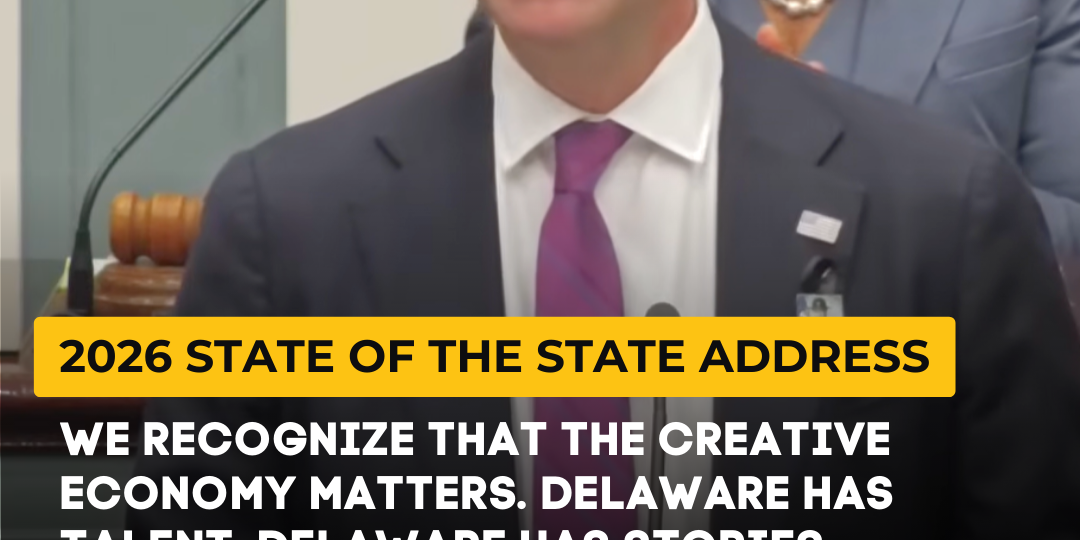
During the annual State of the State Address on January 22, Governor Meyer shared:
“We also recognize that the creative economy matters. Delaware has talent. Delaware has stories. Delaware has potential that can translate into jobs and investment if we take it seriously. So, it does not make sense that Delaware is one of the few states without a film tax credit. From farms and suburbs to big buildings and beaches – we have everything, all within a 90-minute drive at the longest… We’re just going to let so many other neighboring states soak up all of that Hollywood money? I may look more like Clark Kent than Superman, but not on my watch. This is what smart government looks like, it’s what smart investment looks like. Real investment, real return.”
Subsequently, Governor Meyer included $10M in his FY26 recommended budget to establish a new film tax credit. The legislature will next discuss, draft, and pass a final budget by June 30th.
Delaware has the opportunity to support local filmmakers and establish the state as a destination for film and multimedia creators. Continue reading for more information about what current exists, what is recommended by the CREATE Plan, and legislation that may help grow these efforts.
Governor Meyer’s State of the State Address
What Exists Now
In 2015, Delaware lawmakers passed Senate Joint Resolution 5 in the 148th General Assembly to create a Delaware Motion Picture and Television Development Commission. The commission was established to develop a strong motion picture and television industry that would contribute to the State’s economy, enhance social well-being, and showcase Delaware’s “outstanding and unique human and natural resources.” The FY24 state budget, passed in June 2023, included one-time $1M investment in a film incentive pilot. In 2023, regulations were finalized for the Delaware Motion Picture and Television Development Commission, directing procedures to be established for the administration and operation of the Entertainment Industry Fund. The significance of this is that these regulations included direction on processes for evaluating and approving financial incentives as part of a one-time funding ($1M) allocated for film productions in Delaware.
Data from the CREATE Plan, released in 2024, demonstrates the strength of this subsector of the creative economy in Delaware. This research found that Audiovisual and Interactive Media contributes significantly as a primary driver of Delaware’s creative economy and
- Accounts for 32.6% of the state’s total Gross Value Add
- Has a particularly robust presence in Dover, Middletown, and Wilmington.
- Comprises 11% of the state’s total ecosystem 177 assets, but possesses the highest direct output and employment generated.
- Generates a direct output of $851.9 million, which accounts for 31% of the creative ecosystem’s total
- Employs 1,854 individuals (18% of direct employment in the ecosystem).
Furthermore, the CREATE Plan states “Our economic research found that the AV sector has a high Location Quotient (LQ) of 1.81 but a low employment LQ of 0.54, signaling that the state has a higher number of businesses in this sector compared to the national average, but a lower number of employees per business, meaning that the businesses tend to be relatively small. The footprint of the sector, coupled with its small business size, indicate that the sector is in a period of growth and would benefit from additional funding to become more resilient and sustain said growth.”
For purposes of this study, Audiovisual and Interactive Media includes:
- Film & video production, post-production, distribution, exhibition, production supplies, and additional support
- Radio broadcasting
- Audiovisual production, broadcasting, reproduction, and production supplies
- Digital design, programming, publishing, digital hosting and broadcasting
CREATE Plan Recommendations and Alignment
The CREATE Plan articulates how the state can modernize the film and multimedia industry as a strategy to support Delaware’s creative economy. Based on robust community input and research into best practices, The CREATE Plan provides a series of recommendations to help continue enhancing the local film industry including tax incentives.
The plan includes the following recommendations to help Delaware become competitive for local and international film companies:
- Tax Incentives – the first step towards a competitive industry. Delaware is the only state in the region without these incentives, and formalizing this process will help us compete with other states in our region.
- Assistance Programs — The CREATE Plan provides case studies, like Utah (discussed below) that provide assistance to productions with hiring local crews, providing facilities and vendors for production support, developing a comprehensive “film-ready” database of shooting locations in the state, and providing extensive guidelines concerning conflict resolution, sustainability, and diversity.
- Modernizing the Commission to be inclusive of TV, streaming, and audiovisual production – The Delaware Motion Picture and Television Development Commission should update its purview to be inclusive of the wider film and media industries (including TV and other digital formats: podcasts, documentary, streaming, and video games) and increase advocacy for both local and international productions and projects. Modernizing the Commission to be inclusive of TV, streaming, and audiovisual productions more broadly will help bolster the already strong digital broadcasting sector that exists within the state.
- Staff & Funding – The Commission should advocate for increased funding and staffing.
- Guidance & Criteria – A renewed model of support should take into consideration ways to communicate its efforts and clarify the process to different groups, such as:
- A cap for the general film incentive based on the sector’s needs and fiscal capacity.
- Tailored criteria for local and (inter)national productions, considering different production sizes.
- Different criteria for various audiovisual formats, including podcasts, documentary, and video games.
- Inclusive criteria, considering funding quotas for gender and under-represented communities.
- Extensive guidelines for media production in the state, including guidance on sustainability and equity.
- A comprehensive database of film-ready locations around the state.
- A dedicated webpage should explain the role and activities of the Commission, tied in with the proposed One-Stop Shop (see Recommendation 4 of the CREATE Plan – Delaware should streamline applications processes, based on best cases in the US such as the Louisiana incentive.
- Assessment of Impact — Once film incentives are implemented, there should be an assessment of the impact of the incentives, and the Commission should publish reports to make the framework transparent.
Read more from the full CREATE Plan report on pg. 98, linked here.
Case Studies from the CREATE Plan
Utah
Utah demonstrates how a well-rounded legislative program can be the basis for a strong and economically impactful audiovisual sector. It also provides an example of how economic impact research can be used to market and brand a state as being friendly and able to accommodate film and TV productions, as well as highlights the sort of tax credit incentives that Delaware should be seeking to implement into its legislation.
In Utah, the Utah Film Commission, located in the Governor’s Office of Economic Opportunity and the Utah Office of Tourism offers:
-
- Marketing of the state for film, local talent, and promoting locations.
- 20% tax credit. 25% for projects that shoot at least 75% in rural locations.
- Minimum project amounts of $500,000.
- Maximum amounts of $12M for rural productions (60% filmed rurally) or $6.79 for other qualified projects.
- Reporting: For every $1 spent on incentives, $7 enters Utah’s economy through direct, indirect and induced spending
- From 2011-2021, 86% of productions said they would not have chosen Utah without the incentive. 100% for out of state producers.
- These incentives boosted an estimated $6B in film tourism (people coming to see locations from their favorite movies).
Louisiana
Delaware can take from Louisiana the strategy to encourage through tax credits a range of work associated with the audiovisual industry, not just a focus on production. This includes the pre-production and creation stages, as well as post-production such as VFX. It also offers another benchmark for the % tax credit and the amount of budget set aside for this credit that Delaware should seek to emulate in its own legislation.
In Louisiana, the Louisiana Office of Entertainment Industry Development, located within the Economic Development Office, offers:
-
- Up to 40% tax credit on in-state production expenditures for both resident and non-resident labor. Starting at a 25% tax credit baseline, additional incentives are offered for:
- VFX Expenses (5%);
- Screenplay by a Louisiana resident (10% for expenses >$50K but no greater than $5M);
- Rural (60% of principal photography based and occurring outside of the New Orleans Metro = 5% increase)
- A requirement that the production agency is headquartered or domiciled to the state.
- Minimum project amount of $50,000 in-state expenditures required for Louisiana Screenplay productions (by resident screenwriters); $300,000 for all other eligible productions.
- Maximum amounts of $150M per fiscal year. (10% ($15M) reserved for independent productions. 5% ($7.5M) reserved for screenplay productions.)
- The application is available online.
- Reporting: Debuted in 1990 and expanded in 2002 to attract film.
- This effort led to the creation of state-of-the-art studio spaces and built ecosystems that support jobs. Certified over $9B in direct in-state spending. For every $1 credit, $6.12 is generated.
- Supported nearly 10K jobs, over $800M in sales to LA businesses, $338M in earnings for residents, $2.3B in resident payroll.
- Up to 40% tax credit on in-state production expenditures for both resident and non-resident labor. Starting at a 25% tax credit baseline, additional incentives are offered for: