
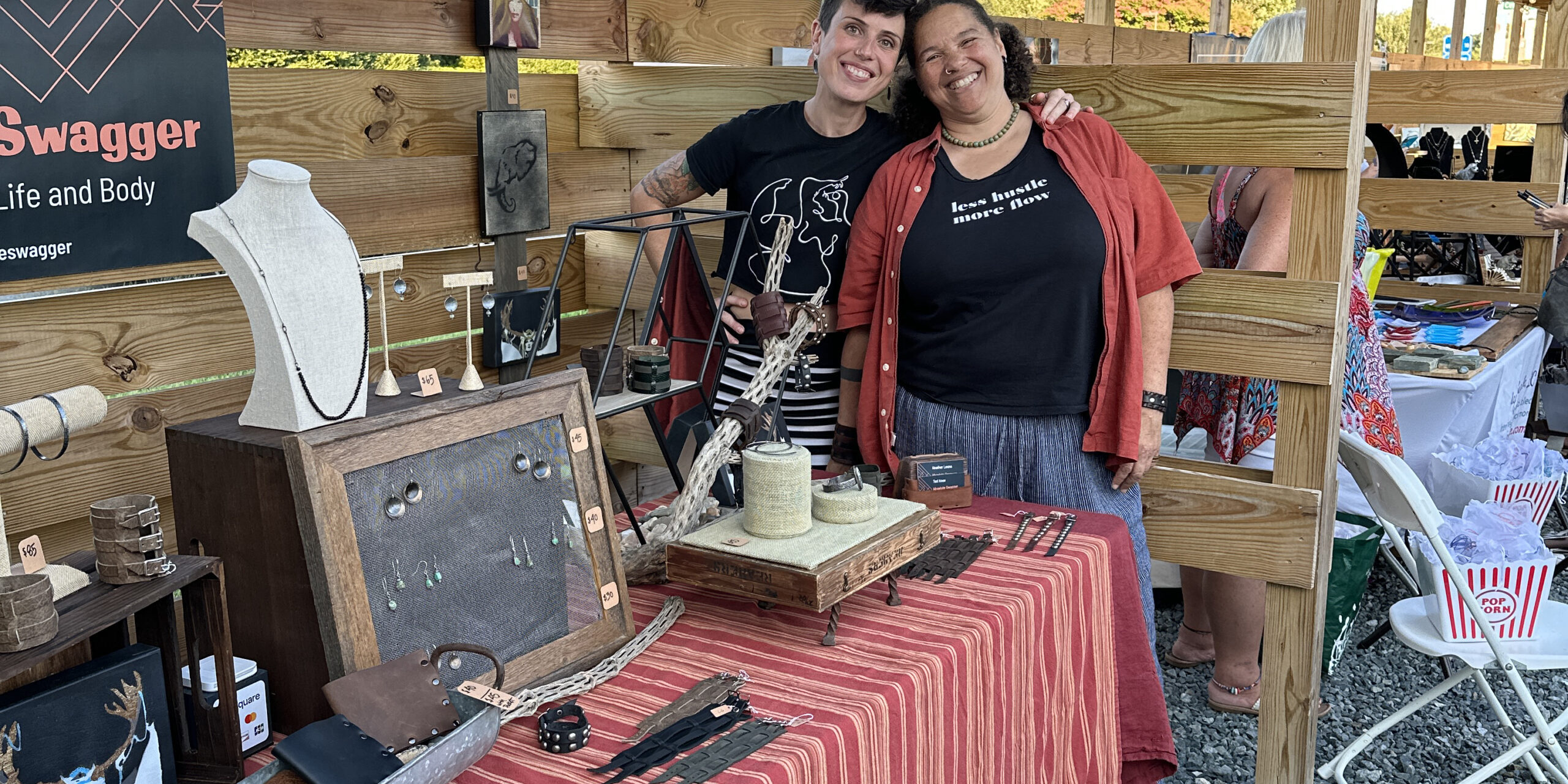
Across Delaware, artists lack both physical space to create and the business tools to build long-term careers. The CREATE Plan addresses this gap by calling for creative hubs in New Castle, Kent, and Sussex counties. These hubs would combine shared workspaces and equipment with direct mentorship, funding connections, and professional training. The plan specifically highlights the need to expand rehearsal and workshop space in southern Delaware, where access remains particularly limited.
Grassroots organizations aren’t waiting for state funding to fill these needs. In Wilmington, West Side Grows Together operates The Creative Hub where local artists lead hands-on workshops, host rotating exhibitions, and plan public art initiatives alongside residents and civic partners. In Rehoboth Beach, the Developing Artist Collaboration functions as an artist-led hub offering mentorship, business education, sales opportunities, and community events. Together, these initiatives show what happens when a community invests in both the infrastructure artists need and the practical skills to sustain a creative career.
Neil Kirschling, Executive Director of the Delaware Arts Alliance, says the CREATE Plan’s hub recommendation grew directly out of what artists told researchers they needed most.
“One of the recommendations in the plan is the establishment of creative hubs in each county,” Kirschling said. “As we heard from artists up and down the state, they’re looking for opportunities to connect with one another. They need rehearsal space, studio space, performance space, and chances to gather, formally and informally, and network with each other.”
“These creative hubs that are already popping up across Delaware really are exemplifying the CREATE Plan,” he added. “They’re providing opportunities for artists to get together, to learn from one another, and to have greater access to resources. If you’re a consumer and you want to buy something from a local artist, it’s so much easier when there are ten artists together presenting their work, as opposed to hunting out one individual in your community.”
JaQuanne LeRoy Daniels is a visual artist and co-manager of The Creative Hub, an initiative of the Wilmington neighborhood revitalization cooperative West Side Grows Together. When the team set out to build the space, there was no existing blueprint to follow.
“The main challenge I found is that we’re kind of creating something that did not have a format for, within an organization that is not specifically art focused,” he said. “We had to be very creative about the research that we were doing and the people that we tapped into as resources. We did a lot of listening to the community, to artists, to businesses, and just to people that we respected, including the Delaware Arts Alliance.”
What made the initiative viable was having an established community organization to back it financially and operationally.
“Having West Side Grows Together be an organization that had the resources to apply for funding, to have the space, and to do the programming that we were doing, really was crucial,” he said.
Beyond securing physical space, Daniels has seen how visible representation changes how artists perceive state resources and grant opportunities.
“We just did an event recently with the Delaware Division of the Arts, and we had a grant workshop for artists,” he said. “The thing that stuck out to me most was one of the artists saying that when she was able to see the people who had applied to this grant and the people who had gotten this grant, and that there were people that she knew, it made her feel like this was something that she had access to.”
In Rehoboth Beach, Leah Beach took a different path to solving the same challenge. What began in 2016 as a pop-up holiday shopping event among friends has since expanded into the Developing Artist Collaboration (DAC), a full workforce development hub for Sussex County creators.
For Beach, supporting those creators starts with helping them define their business strategy first. “The most important thing that we do is we get artists to understand why,” she said. “Once they have a really clear understanding of exactly what they do and how they want to diversify it and how they want to grow it, we then help them with tools and resources, expert support.”
Despite building DAC from the ground up, her advice for expanding creative spaces echoes JaQuanne’s experience of leveraging an established organization.
“I would strongly recommend not building an organization from the ground up,” Beach said. “I would strongly recommend someone who’s passionate about a program to partner with a great institution that could use more programs.”
The primary hurdle to launching those hubs remains initial capital. “A lot of these types of hubs come with a lot of upfront investment, and it’s very difficult to get that investment either when you’re just starting out an organization or you’re a nonprofit,” she said.
When communities overcome that barrier, the economic return for local creators is immediate. The West Side Creative Market operated by DAC has generated $1.7 million in artist sales.
Kirschling sees that same economic logic driving talent retention statewide.
“I think creative hubs are one way we can incentivize individual artists to locate in Delaware, or stay in Delaware,” he said. “If you’re from here, you don’t have to go to a bigger city outside of Delaware to have access to resources in the creative economy. You can have those right here.”
Kirschling frames that same gap in access as an equity issue the CREATE Plan is trying to solve.
“The other benefit of this concept of a creative hub is it’s one strategy to get at the issue of equitable creative economy development,” he said. “Certain parts of Kent and Sussex, in particular, have real access challenges, where people have to drive a long distance for basic performance spaces, studio spaces, lessons. By creating these creative hubs, we can put opportunities for the arts to thrive in communities all across the state.”
For Itzel Aguilar, a muralist and 2026 Delaware Division of the Arts Individual Artist Fellow based in Georgetown, the need for a hub is something she runs into constantly, working in a part of the state that doesn’t have one.
“We don’t really have any cultural centers in southern Delaware,” she said. “And if it is, it’s very small. Northern Delaware has pretty strong resources, and I feel that sometimes it gets trickled down,” she said, “but we don’t really have strong organizations. We have very few. We are lacking cultural centers as well.”
Transportation compounds the problem. “Are you supposed to be always going up to northern Delaware for resources?” she said. “A lot of the resources that can help people with things beyond art — business resources, like, hey, here’s how you apply for grants — things like that that could be done at these hubs.”
Ultimately, she sees these shared spaces as vital connectors for local talent. “Creative hubs would be a wonderful resource for many artists in each county,” Aguilar said. “That way they can collaborate, exchange ideas. And I think overall it just builds a sense of community as well among artists.”
Daniels agrees Wilmington’s model isn’t the finish line. What he’d like to build next is a place for artists to actually stay and work, not just pass through.
“One of the things that we haven’t been able to take on is offering more studio residencies for artists,” he said. “Having a space to create is a big challenge for artists, and I can only imagine if it’s a challenge in Wilmington, it’s probably just as much a challenge in other places.”
Kirschling agrees that these creative hub models are proven. The question now is how to fund and replicate them.
“I think we’re in the proof-of-concept phase at the moment,” Kirschling said. “There’s exciting work popping up in all of the counties, and continuing to invest attention in these efforts and promote their successes will help engender additional financial support for this type of work. The beauty of creative hubs is the flexibility — they can happen in arts nonprofits that have the space and the mission to focus on this, or in community development organizations that aren’t related to the arts but want to set aside a particular space for artists. If we attack this as a tool for business, for workforce development, for economic development, it’s possible we can unlock funding sources for the arts that aren’t specifically earmarked as arts funding, but are available for business development at large.”
The CREATE Plan does not prescribe a single model for what a creative hub must look like. A hub can operate as a state-supported initiative, a fully private entity, or a public-private partnership, sustained through memberships, space rentals, ticket sales, or local sponsorships. The Creative Hub and the Developing Artist Collaboration did not wait for state policy to catch up. Both organizations identified local gaps and built spaces to fill them from the ground up.
“It would be really cool if hubs were something that were more spread out,” Daniels said. “Maybe we’re talking about one in every county, but I’m thinking one in every neighborhood.”