Hear more testimonies from:
The Delaware Division of the Arts (DDOA) is showing what it looks like when the CREATE Plan’s vision comes to life.
Strategic investment and cross-sector partnerships are extending the reach of the arts across Delaware, demonstrating how creativity improves well-being, strengthens communities, and builds a more vibrant creative economy.
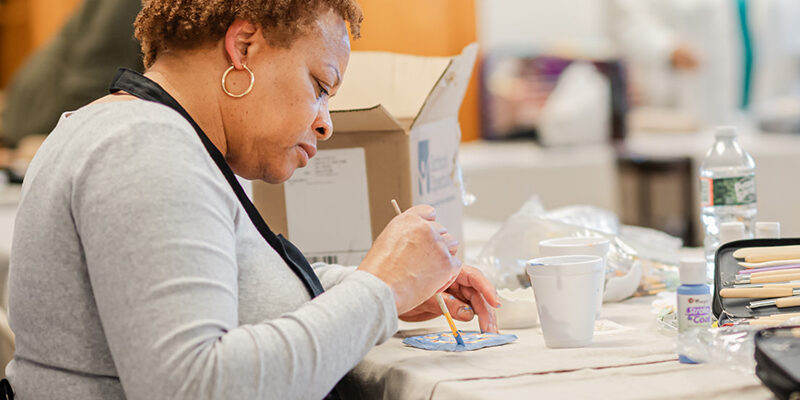
Programs like Creative Aging are a leading example of how collaboration can bring the arts into community spaces and make creativity more accessible. As Jessica Ball, Director of DDOA, explained, “Our Creative Aging Program is designed and marketed to adults age 55 and up. And it is really about creating a safe place where folks can come and learn a new skill, a new craft, in a very supportive and social environment.”
For veterans and their caregivers, the CreatiVeterans program offers meaningful connection while also creating new opportunities for teaching artists.
“It really has helped bring people together, create a sense of community amongst veterans, really foster that self-exploration in terms of folks exploring their own creativity,” Ball said. “It is a really wonderful opportunity when they come together for a culminating event to share what they’ve made during those classes with their friends, with their families, with other veterans in their communities.”
The impact goes beyond participants. Teaching artists and host sites say the programs bring new energy and help build connections.
“We are forming new social connections, not only among the participants, but among the teaching artists as well,” Ball observed. “If these classes are a way to introduce folks in the community to their local libraries, to their local nonprofit organizations, I think it’s just a win-win.”
These outcomes highlight why public funding is critical. As Ball stressed, “It is important for us to make sure that every Delawarean has as much access to the arts as possible because of the positive benefits that come from participating in the arts.”
Neil Kirschling, Executive Director of the Delaware Arts Alliance, points to the deeper shift this represents.
“They [DDOA] have really begun putting in place new programs that exhibit the ideals of the CREATE Plan, which is that it shouldn’t just be art for art’s sake, but the arts should be embedded into many other sections of the world. The arts as a whole benefit health, education, tourism, economic development. The list goes on and on.”
That mindset has already led to progress.
“Thanks to advocacy from Delawareans up and down the state over the past three years, the state has increased the amount of funding that it’s allocating towards the Delaware Division of the Arts,” Kirschling said. “That funding goes back out through grants into the community. And so I think that’s a really good example of progress that’s been made in the past year.”
Still, more work is needed. As Ball explained, sustained and equitable funding helps organizations avoid mission drift and build authentic relationships with communities. “One of the most important things that we can do at DDOA is to provide stability for the arts and culture sector,” she said. This progress directly advances CREATE Plan Recommendation #13 to expand equitable arts funding, ensuring resources reach more organizations and communities across Delaware.
Last year, DDOA spoke to arts organizations across the state for Arts Alive Delaware, a documentary series highlighting the work of nonprofit arts and culture groups. In these interviews, two themes came through strongly: the need for sustained funding and the importance of partnerships.
Pat Gallagher of the Developing Artist Collaboration emphasized, “When you’re not in a big city, it’s so vital to continue to support these organizations and the culture in your area to ensure that the people that are really putting all the hard work into keeping those things going can keep going.”
Arreon Harley-Emerson of Elevate Vocal Arts put it even more directly, saying, “It’s important that we financially support the arts as well because arts ain’t free. Nothing in this world is free. It takes investment. And I say the word ‘investment’ because a lot of people think, well, the arts, it’s their nonprofits, their charities. No, art is not ornamental. It is absolutely fundamental to every aspect of our life.”
Leaders also underscored how partnerships expand the reach of the arts. Joe Gfaller of Clear Space Theatre shared, “Partnerships that we’ve done across the community, I believe, create an opportunity for us to elevate other organizations in the eyes of our patrons, but also allow us to help people recognize that there’s a critical role the arts play in helping to shape, evolve, grow and transform our communities for the better.”
Conversations about funding and collaboration always came back to making sure people understand why the arts matter. As Molly Giordano of the Delaware Art Museum put it, “I would always ask community members to ask yourself, ‘What would my life look like if the art museum, the symphony, any number of organizations you love weren’t here? How would this impact the quality of our life? What would our state look like?’ And that is the answer to why you should support the arts.’”
Looking ahead, the CREATE Plan continues to guide policymakers, artists, and community partners.
Jessica Ball emphasized, “We can look to the CREATE Plan as a roadmap that we’re all working off of towards these common goals to make Delaware a better place to live, a better place to grow, and a better place to call home.”