
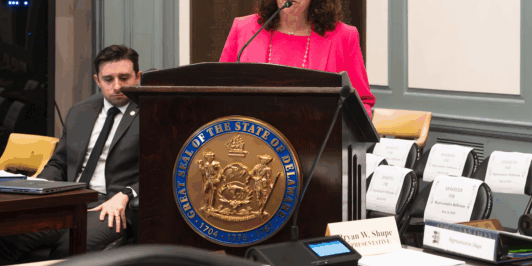
Delaware is making real progress toward building stronger pathways for students who want to pursue careers in the creative economy. Senate Concurrent Resolution 109, passed in June of 2025, was an important step forward, directing the Department of Education, Department of Labor, and Workforce Development Board to study how the state’s Career and Technical Education system can better prepare young people for creative careers.
This work directly advances CREATE Plan Recommendations #16 and #17, which call for stronger career development opportunities in secondary education and the expansion of arts-related pathway courses and degrees.
Secretary of Education Dr. Cindy Marten emphasized why this work matters for both students and the state.
“The arts give you a life that’s worth living,” she said. “When we help students understand that the thing they love to do, the thing that sets their soul on fire, can actually be their career, that’s how you make learning relevant. That’s a vision for Delaware.”
Marten added that this vision is not just about individual fulfillment, but also about preparing for a rapidly changing economy. “A lot of jobs will eventually be replaced by technology,” she explained. “AI will never be able to replace our creativity. That’s why this is exactly the moment to lean into the arts and create a pathway in our schools.”
At Odessa High School, art educator Brianna Shetzler guides students through an arts pathway program that culminates in capstone projects tied to real-world experience.
“These hands-on experiences are the driving force,” she said. “When students work alongside art professionals, they make the connection between what they’ve learned in the classroom and how it applies to the workforce.”
From fashion design to museum studies, her students are discovering careers they might never have considered without that exposure. Each project, she noted, helps them understand that their creativity is not just personal expression but professional preparation.
Shetzler emphasized, however, that these opportunities are not consistent across the state. “As of now, it is up to the districts, and it’s very inequitable from district to district and even school to school. If we provided more state funding, that would create equitable access across the state.”
Without that investment, she warned, Delaware risks losing the very students it hopes to nurture. “If we don’t invest in the arts while students are here, they go to college somewhere else and they don’t come back. If we support them early and create opportunities in Delaware, they will return and strengthen our workforce.”
For recent Cape Henlopen High School graduate Samuel Mincey, the impact of that support is clear. Now studying music education at Syracuse University, he sees his high school experience as the foundation for his career.
“My collaborative skills are mostly due to being a musician, he said. “It’s all about watching and listening. You have to be locked in or the whole thing will fall apart. Those experiences molded me into the musician I am.”
Like Shetzler, Mincey pointed to equity as a critical issue. “Money should never be an obstacle when it comes to the arts,” he said. “If a child wants to pursue music or painting or dance, they should have that opportunity no matter where they come from.”
Mincey’s experience reflects what the CREATE Plan envisioned: students discovering viable careers in the arts and gaining real-world skills that prepare them for the workforce. But those opportunities are not yet guaranteed for every student. For Neil Kirschling, Executive Director of the Delaware Arts Alliance, that’s where statewide action becomes essential.
“It’s a really great sign of progress when local districts create their own arts pathways,” he said. “Imagine with statewide support what that could look like for all students, not just the ones who happen to live in those districts that have already committed the energy and resources. We want these opportunities available to all students regardless of where they’re born or what school they attend.”
He added that SCR 109 is a key step toward making that vision real, since it advances two of the CREATE Plan’s recommendations: supporting workforce opportunities for students and expanding arts-related pathways statewide. Without that broader system, he cautioned, Delaware risks a “brain drain,” as young creatives often leave the state looking for opportunity.
“You can make a living as a creative here in Delaware,” Kirschling said. “And certainly we need to put in place the supports for those students to be able to get connected to jobs and then also sort of build some of those jobs and build some of those industries here if they don’t already exist.”
Delaware already has more than 10,000 jobs tied to its creative economy, and the potential for growth is significant. To build on the momentum of the CREATE Plan, leaders and partners will need to expand funding, strengthen partnerships between schools and employers, and ensure that every student—no matter where they live—has the chance to pursue creative careers.
As Marten reminded us, “The arts are not just a passion, they’re a profession…I think Delaware’s future depends entirely on how boldly and really thoughtfully we’re able to do this.”