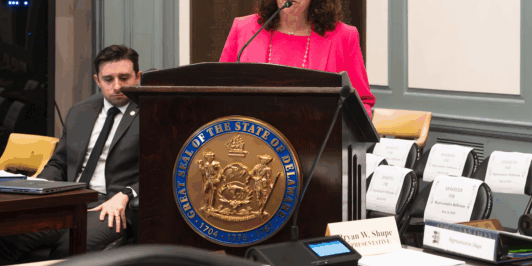
“I see arts education as connected to jobs, to the economy, to outcomes, and most importantly, to students who sometimes feel the most disconnected from school, who now have ways to connect through pathways in arts education. I’m not just a strong supporter and believer, but I’ve seen it in action.” – Secretary of Education Cindy Marten at Delaware House Education Committee, June 24, 2025
Passed: SCR109
Delaware Arts Alliance and members of the Arts & Culture Caucus successfully championed the passage of Senate Concurrent Resolution 109. This resolution begins a process to evaluate and enhance education and workforce pathways supporting the creative economy, with a focus on inclusivity, accurate labor data, and expanding student opportunities and to report findings by early 2026. The passage of this resolution builds upon the work of implementing the CREATE Plan, as it encourages the state to recognize the impact of Delaware’s creative economy, which produced $3.7B in economic output in 2021 alone, as well as promoting access to the viable and valuable educational and career opportunities available for students pursuing the arts. This is a critical step towards developing deeper connections between Career & Technical Education (CTE), Delaware Pathways, and the arts.
How did we get here?
- Legislators hear demand from the field that Delaware has the opportunity to explore additional statewide supports and connections between the creative economy and Delaware Pathways.
- The CREATE Plan recommends greater connection between Delaware Pathways and the Creative Economy based on focus groups and survey input of hundreds of Delawareans including educators, artists, and employers. Read the Arts Education One-Pager here.
- At the Arts and Culture Caucus Meeting of the 2025 March for the Arts Advocacy Day a panel of educators, current students, recent graduates, and creative economy employers provided insight on the existing pathway system and illuminated equity gaps and ways we can further support artists building their skills and careers in Delaware.
- Delaware Arts Alliance worked with Senator Lockman to draft legislative language, involve the Department of Education in providing feedback and edits, and seek sponsorship. From there,
- On June 17, Senator Lockman, Prime Sponsor, introduced the resolution in the Senate, where it passed unanimously by all state Senators.
- On June 24, SCR109 was heard in the Delaware House Education Committee, where sponsors Representatives Gorman and Shupe, several other legislators, and Secretary of Education Marten provided comments in support of the resolution and contributing their individual connections to the arts.
- On June 26, SCR109 passed in the House, becoming law and heading to the Department of Education to lead implementation.
Thank you, Delaware General Assembly and arts advocates for your support of arts education! With your help, we are proving that the advancement and investment of the arts in Delaware is a priority for our communities.
Who was involved?
The resolution featured bipartisan sponsorship in both chambers:
- Primary Sponsor: Sen. Lockman
- Additional Sponsors: Sen. Buckson, Rep. Gorman, and Rep. Shupe
- Co-Sponsors: Sen. Cruce, Sen. Hoffner, Sen. Sokola, Rep. Griffith, Rep. Morrison, Rep. Osienski, and Rep. Kamela Smith
The resolution garnered full support of the House and Senate.
What will happen as a result of this resolution?
Senate Concurrent Resolution 109: DIRECTING THE DEPARTMENT OF EDUCATION, IN COLLABORATION WITH THE DELAWARE DEPARTMENT OF LABOR AND THE DELAWARE WORKFORCE DEVELOPMENT BOARD, TO EVALUATE AND REPORT ON OPPORTUNITIES FOR DELAWARE PATHWAYS TO SUPPORT THE CREATIVE ECONOMY.
The resolution requires that by February 26th,
- The Delaware Department of Labor will update Delaware Labor Market Information to more accurately reflect careers in the creative economy
- The Delaware Workforce Development Board will recommend to the Governor an employer to represent the creative economy on the Workforce Development Board
- The Delaware Department of Education will inventory existing Career and Technical Education pathways associated with the creative economy, and assess additional demand
- The Delaware Department of Education will outline next steps and options to develop student participation in state-approved CTE pathways associated with creative economy careers
What happens next?
The DAA is listed in the resolution as a supporting organization for implementation, and we have offered our in the development of the report due February 2026.
- Stay connected for updates! Sign up for our Newsletter & Follow Us on Social Media
- Let us know if this topic particularly interests you, and we will make sure to keep you abreast of any opportunities that come up for additional public engagement and discussion. (Email: info@delawareartsalliance.org)
Continue reading below for comments provided at the House Education Committee by Reps. Gorman, Shupe, Williams, Neal, Chukwuocha, as well as Secretary of Education Marten and DAA’s Executive Director, Neil Kirschling.
House Education Committee Remarks
“This resolution will help identify additional opportunities to connect young, creative Delawareans to career and educational opportunities. Promoting the creative economy as a viable and valuable career pathway for professional development will enhance overall employability and educational opportunities for students while supporting the state’s long-term economic growth. Delaware has strong arts programs, it has strong pathways programs, and now we have the opportunity to be one of the first states in the country to figure out how to systematically support arts and workforce development in our K-12 schools statewide. Thank you to the legislative sponsors for championing this resolution. Thank you to Lauren Conrad and Jon Wickert at the Delaware Department of Education for their work on behalf of Delaware’s students and for your involvement in strengthening this legislation. The DAA looks forward to being a partner in the next steps.”
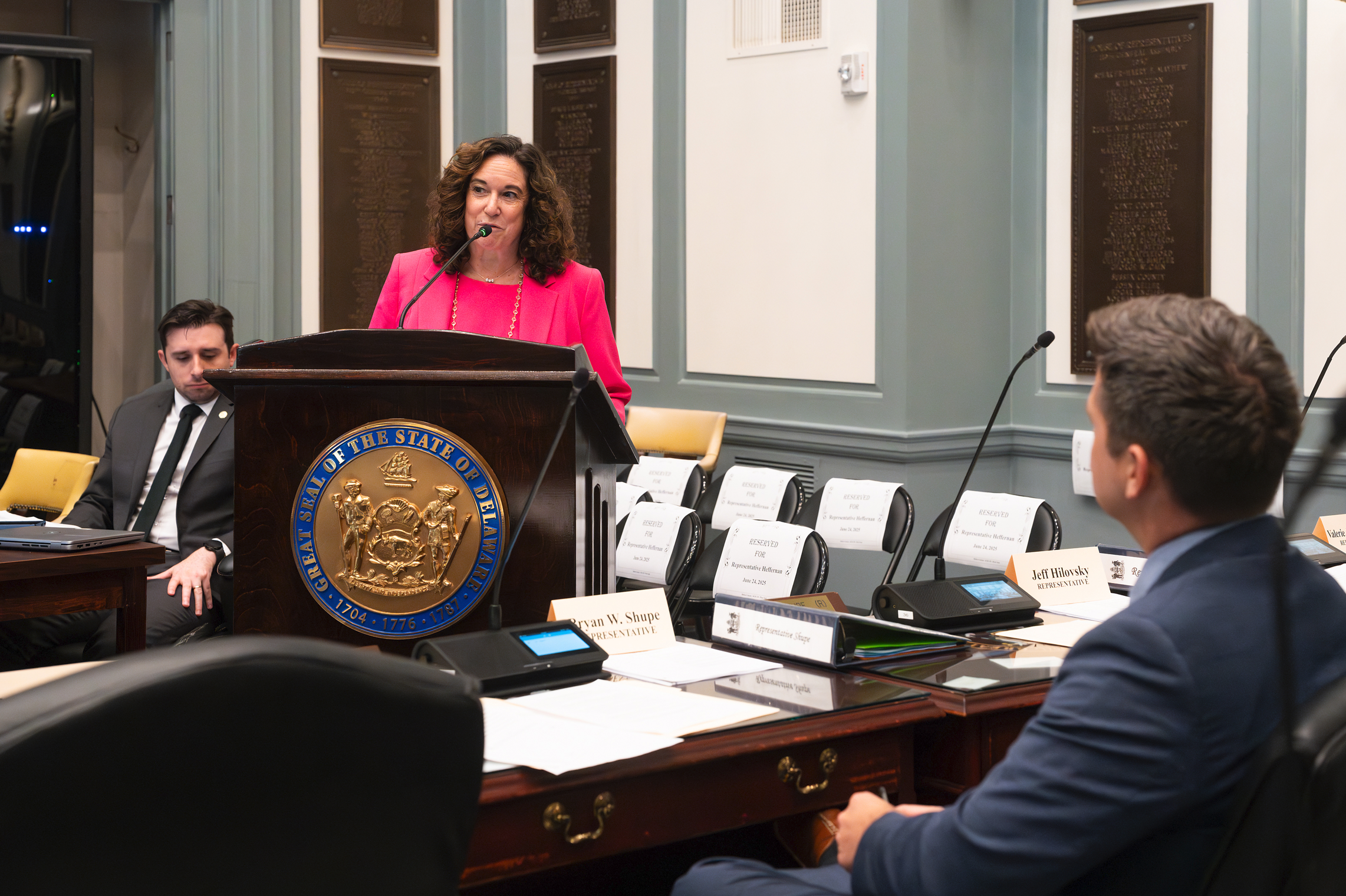
“This is such an important step forward for arts education. If you have heard me talk about education for more than 10 minutes – you’ve heard me talking about the importance of integrating arts education in a robust way that delivers positive outcomes to students.
Literacy, math and science outcomes can be improved when you integrate arts fully into education. I’ve seen it firsthand as a principal at an inner-city school in San Diego. We integrated the arts into literacy and math using Title 1 funds, which in the beginning were meant for literacy and math improvements. When we aligned arts standards to literacy and math standards, a population of 1,000 students Pre-K through 5 (100% of them qualifying for free or reduced lunch, 85% of them English language learners) received an arts integration program that gave them access to the arts to learn literacy and math standards, resulting in literacy and math standards improving because we were integrating the arts in an intentional way.
That’s a one school story. When we move forward in Delaware with creating more robust pathways, it goes beyond just integrating it, getting math and literacy outcomes; it’s the economy, and it gives students a way to connect to school. When you build a pathway that goes from preschool through high school and connects you to jobs – you see that there are so many arts careers, literally jobs in the arts. I see arts education as connected to jobs, to the economy, to outcomes, and most importantly, to students who sometimes feel the most disconnected from school, who now have ways to connect through pathways in arts education. I’m not just a strong supporter and believer, but I’ve seen it in action.“
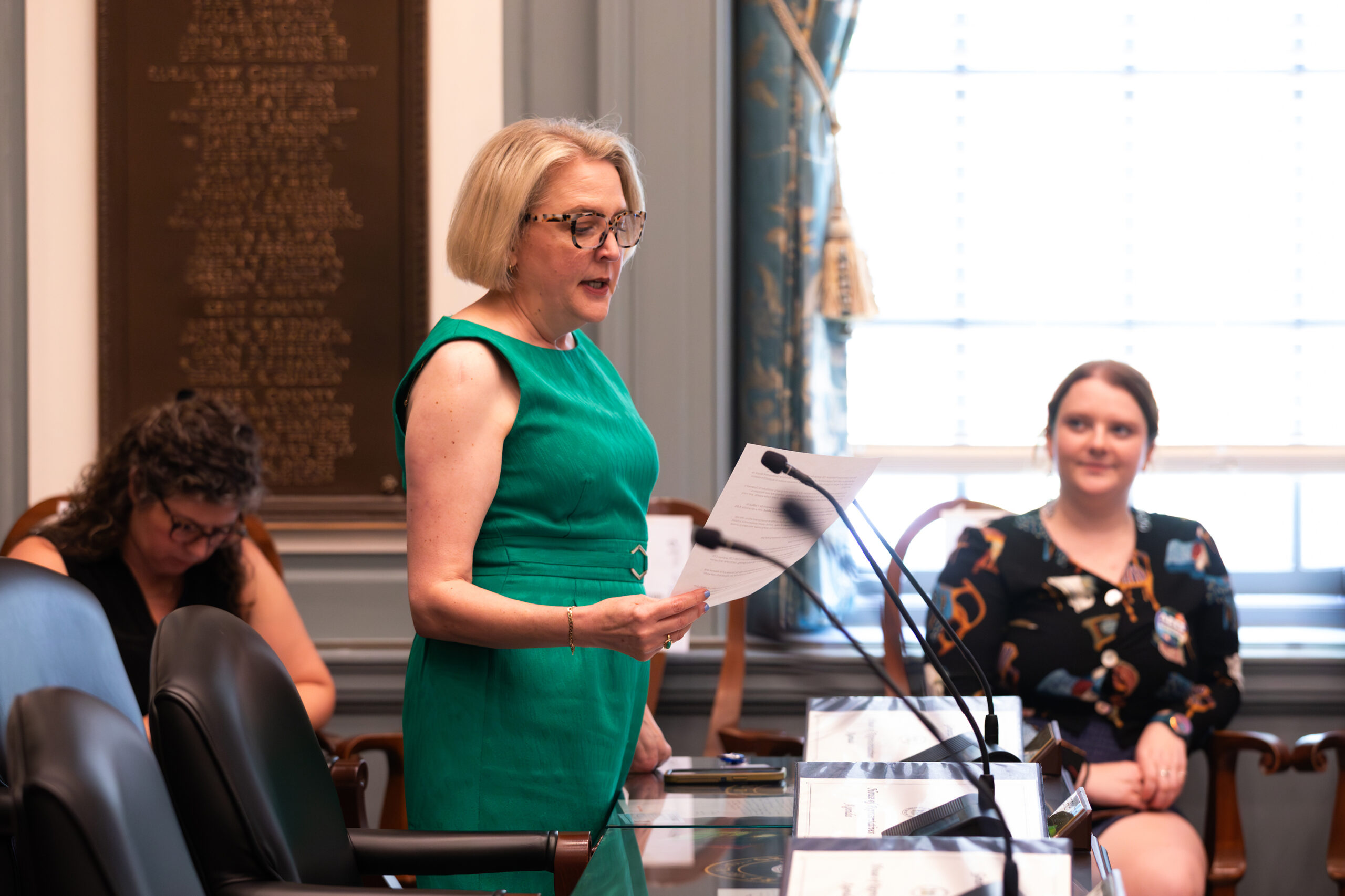
“The creative economy provides a rich multicultural life. It includes artists and designers, certainly, but also film makers, educators, event organizers, publishers, culinary professionals, digital media experts, and many more. According to the CREATE Plan, Delaware’s creative economy generated $3.7 billion in economic output and contributed $2.2 billion dollars in Gross Value Added, with a remarkable 9.5% growth rate in 2021, outpacing many traditional sectors. Yet, this sector remains underrecognized in our workforce development efforts. We see under representation of women and people of color, limited career advisement in schools and few formal apprenticeships or training opportunities for young people who want to pursue creative careers.
I just want to add personally, this was true for both of my children and particularly for my younger son. They both chose the engineering pathway because they wanted something more creative, and there wasn’t much else available to them. My younger son is now studying studio art in college, but he went on a long detour looking at schools for engineering programs before he figured out what he wanted to do. I think that it would have been a lot easier for all of us if he had had that opportunity in high school.
This resolution takes a clear step toward addressing that gap, and it does 3 important things:
- Updates labor market information to ensure creative economy jobs are accurately represented so students, families and counselors can make informed decisions.
- Inventories and strengthens career pathways including both CTE and non CTE options, so more students have access to real-world learning, mentorship and career exploration in creative fields.
- Engages employers and cultural institutions like Delaware Arts Alliance and the Division of the Arts to shape education programs that are aligned with real world workforce needs.
It’s important when we talk about workforce readiness to remember that not every student’s path leads to a cubicle or a lab bench. Some lead to studios, film sets, community theaters, music venues and design firms – and those paths are just as essential to our economy and our communities. By supporting SCR 109, we are recognizing that creativity is not just a personal strength; it is a professional asset. We are helping more Delaware students turn their passions into viable careers, and we are building a more inclusive, resilient economy in that process.”
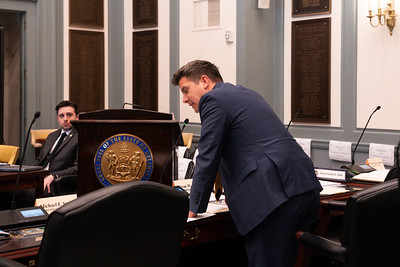
Rep. Shupe thanked the Delaware Arts Alliance for their commitment to supporting the arts in Delaware, and to Neil Kirschling for his leadership. He expressed excitement for the Arts & Culture Caucus and the outcomes of the resolution, saying “I’ve been involved in many task forces and groups over the years, and it’s exciting to see the work of the Arts & Culture Caucus coming to fruition.”
Rep. Williams shared her connection to the arts through her daughter – a talented print maker living in New England.
“[My daughter] went to Emerson and studied graphic arts. She works for a worldwide science journal, but on the side, she does prints. She has done videos in Boston where they record her, it’s beautiful what she does. I appreciate these types of programs that connect the two pieces of the arts – entrepreneurship/business and creativity. Thank you for bringing this forward.”
“All four of my children are arts-based children… One of the most heartbreaking things we have seen is the diminishing of art pathways. My oldest daughter was a DCAD student, a first year during the school’s last year, and it was heartbreaking when she called to tell me her school was closing. I am so grateful to see this resolution. Arts come in so many forms, and I’ve realized it in my own children’s education. I look forward to seeing how this resolution will impact Delaware and our students.”
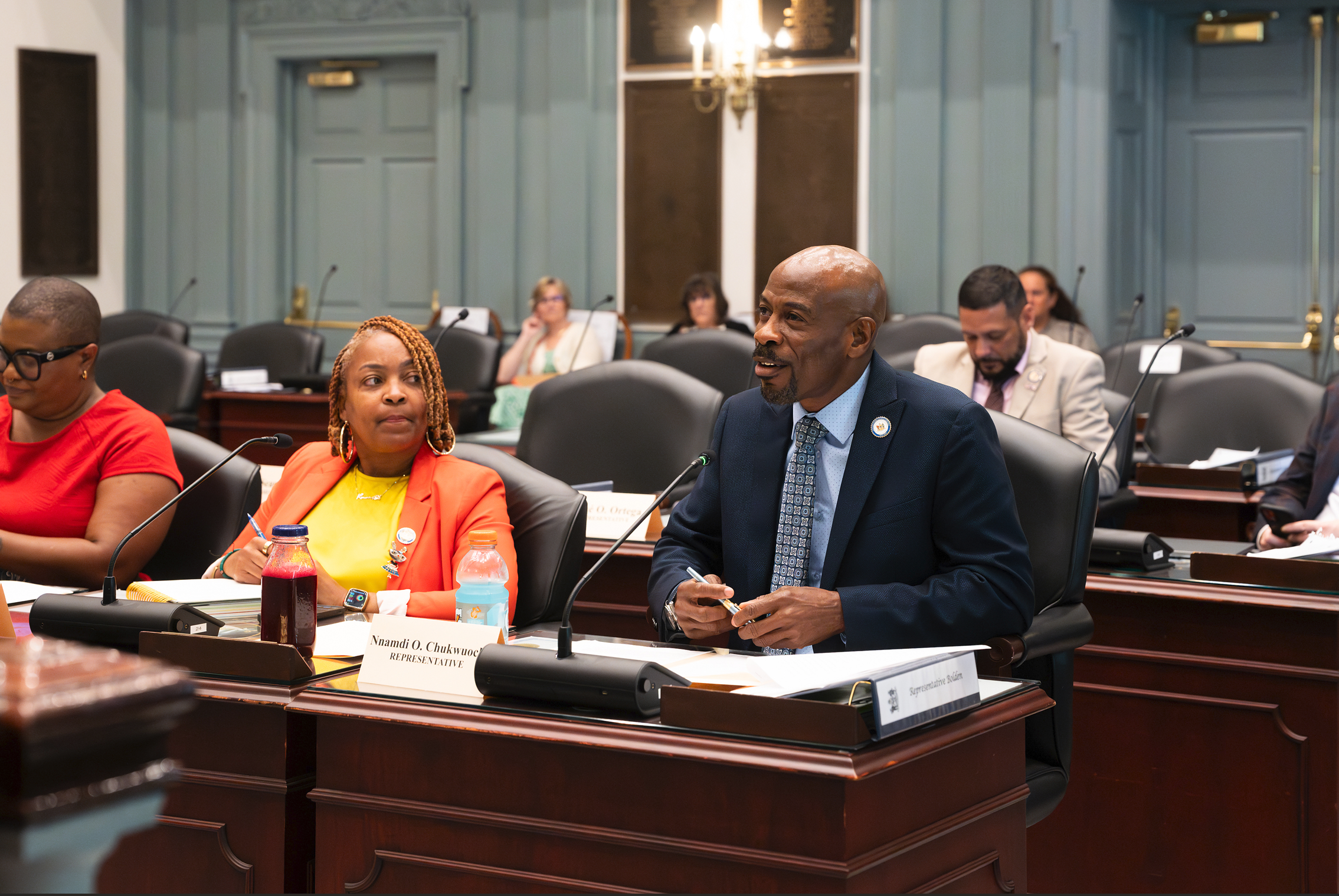
“As a professional artist and witness of the power of Wilmington’s Public Schools – you can see the need for more direct arts engagement for our students… Programs from Delaware Humanities and the National Endowment for the Arts, provide artist residencies for inside of schools, showing our students that art is a way of life. Arts can be your career.
Since the early 2000s, my brother and I have been honored to mentor and share with students that there is an opportunity to take what is inside of them. We often say to them, this journal, our journals, will take us around the world…
As a proud board member for the Cultural Restoration Project Beyond Bars Program, so many arts-based programs inside of schools need to increase the student’s incentives to see the value of the arts, not just what they see on TV, but what can impact your everyday life. Thank you to the sponsors for bringing this forward.”